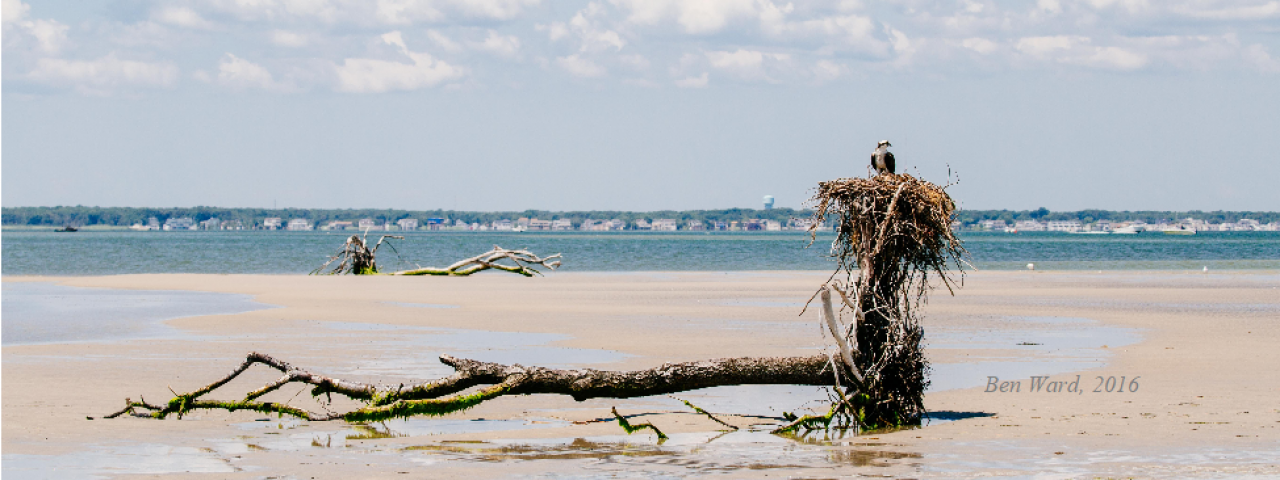
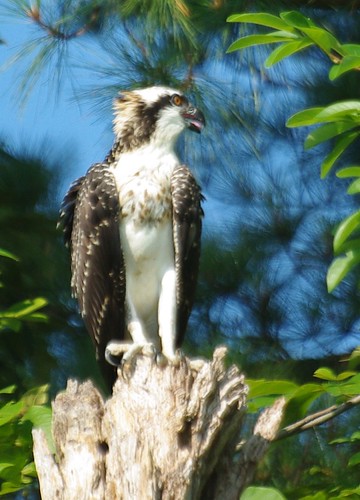
In the Norther Hemisphere osprey mate during the spring and raise their brood through the summer, before returning to their wintering grounds further south. Osprey are monogamous and return to the same nests every year, which makes monitoring them easier. Project Osprey Watch compiles data globally from every nest that is actively being monitored each breeding season. Therefore, the project relies heavily on the active participation and reporting of volunteers and other citizen scientists. Volunteers are wonderful and their hard work has provided tremendous benefits to ecological studies, however, they are not without their limitations. Relying on volunteers to provide consistent reporting on the same nests year-after-year is not feasible. For this reason, data from Project Osprey Watch should be weighted accordingly and compared against data from scientific researchers and institutions. For instance, the annual data from Project Osprey Watch (see table below) shows a peak nest abundance in 2013 and then a dramatic decrease in numbers every year after. However, according to IUCN, Osprey status is “Least Concern,” and in the U.S. populations have been steadily increasing for thirty years. Therefore, the decrease in nest abundance seen in the Project Osprey Watch dataset does not signify an actual decrease in abundance, just a decrease in reporting.
Although the “Number of Active Nests” has steadily decreased every year since 2013, this does not correspond to the actual trends observed in osprey populations of the United States. In fact, the first six metrics in this graph are more representative of the number of active “nest watchers” per year, than they are of the number of active osprey nests. This is a typical shortfall of many projects which rely on citizen scientist volunteers and does not mean the project is unusable. The important metrics to highlight in this graph are the last two columns; “Number of Young Produced per Active Nests” and the “Number of Young produced per Successful Nests.” This is because these observations are averages of all the nests observed per year, not totals; which is why the “Number of Young Produced per Successful Nest” in 2013 is the same as it was in 2017. In other words, the number of volunteers is inconsequential when averaging all the observations. Therefore, these metrics are representative of the actual clutch numbers each year, whereas the “Number of Active Nests” is merely a count which varies annually based on available volunteer support.
| Year | Number of Active Nests | Number of Successful Nests | Number of Failed Nests | Number of Young Produced | Number of Young Produced per Active Nests | Number of Young Produced per Successful Nests |
| 2012 | 779 | 529 | 126 | 986 | 1.3 | 1.9 |
| 2013 | 1228 | 928 | 235 | 1831 | 1.5 | 2 |
| 2014 | 836 | 580 | 230 | 1102 | 1.3 | 1.9 |
| 2015 | 762 | 531 | 216 | 1014 | 1.3 | 1.9 |
| 2016 | 598 | 400 | 154 | 797 | 1.3 | 2 |
| 2017 | 501 | 305 | 162 | 595 | 1.2 | 2 |
| 2018 | 466 | 336 | 82 | 647 | 1.4 | 1.9 |
| 2019 | 82 | 10 | 7 | 13 | 0.2 | 1.3 |
| Table 1: Source: Project Osprey Watch |
Project Osprey Watch has been a tremendous resource for many conservationists and wildlife managers. Perhaps the best example of this is in the state of New Jersey, where every single known osprey nest in the state has been registered in the program. Furthermore, according to the Conserve Wildlife Foundation of New Jersey, “the majority of data collected during a census is by citizen scientists, or Osprey Watchers, and specially trained volunteers.” They go on to say, “From the data that is collected, it is used to help determine the overall size and health of the population, while engaging the public in osprey management and conservation, a key factor in the long term sustainability of ospreys in New Jersey.”
As mentioned in the introductory post, the goal of Project Osprey Watch is to gather data to help address the three major threats to osprey populations: environmental contaminants, depletion of fish stalks, and climate change. The Center for Conservation Biology (CCB) is “a principle advisor to government and non-government agencies responsible for the management and recovery of avian species at risk.” As such, data from Project Osprey Watch is used in New Jersey to help guide the State’s Wildlife Action Plan.
 Project Osprey Watch